
What Port St. Lucie homeowners actually spend over 20 years
When you’re comparing wood vs. vinyl fencing for your Port St. Lucie property, the price tag you see on the estimate is only the beginning of the story. Wood fence installation typically runs between $15 and $35 per linear foot depending on the species, height, and style you choose. Cedar and redwood command premium prices but offer natural rot resistance, while pressure-treated pine sits at the lower end of that range. For a typical 150-foot perimeter fence around a backyard in the Tradition or St. Lucie West neighborhoods, you’re looking at roughly $2,250 to $5,250 in upfront costs.
Vinyl fence installation carries a higher initial investment, usually ranging from $25 to $50 per linear foot for quality materials and professional installation. That same 150-foot project would run $3,750 to $7,500. At first glance, wood appears to be the budget-friendly winner, and for homeowners with tight upfront budgets or short-term ownership plans, it often is the right choice.
But here’s where Florida’s climate changes the math entirely. The Treasure Coast’s relentless UV exposure, high humidity, and salt air near Fort Pierce and coastal areas accelerate wood deterioration significantly faster than in northern climates. A wood fence requires restaining or resealing every two to three years to maintain its appearance and structural integrity. Each maintenance cycle costs $500 to $1,500 depending on fence size and whether you hire a professional or tackle it yourself. Over a 20-year period, you’ll invest an additional $3,500 to $10,000 in maintenance alone, not counting board replacements from rot, warping, or termite damage that are common in Southeast Florida.
Vinyl fencing, by contrast, requires almost zero maintenance beyond an occasional rinse with a garden hose. It won’t rot, warp, or fall victim to termites, and quality vinyl holds its color through years of intense sun exposure. When you factor in the maintenance savings and longer lifespan, vinyl often proves to be the smarter long-term investment for Treasure Coast homeowners planning to stay in their homes. Veterans Fence Contractors helps customers in Port St. Lucie weigh these trade-offs honestly during free consultations, showing real numbers based on local conditions rather than national averages that don’t account for Florida’s harsh environment.
The maintenance commitment behind wood’s warm aesthetic
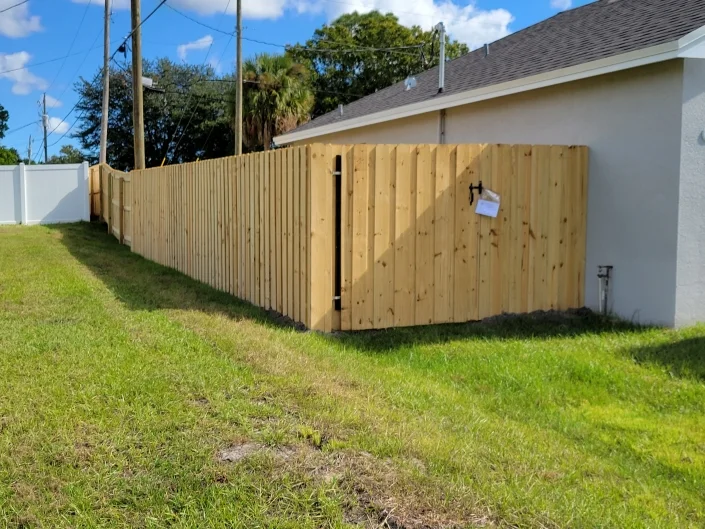
There’s a reason wood remains a popular fencing choice even with modern alternatives available: nothing quite matches the warmth, texture, and organic character of natural wood. A well-designed wood fence can complement any architectural style, from the Mediterranean homes common in Indian River Estates to the contemporary builds in newer Port St. Lucie developments. Wood offers unmatched design flexibility. You can choose vertical pickets, horizontal slats, lattice tops, custom heights, or decorative post caps. Staining lets you select any color from natural cedar tones to bold custom hues, and you can change that color down the road if your landscape design evolves.
Wood fence installation also makes sense when you need a fence quickly or have complex terrain. Wood is easier to adapt to slopes, irregular property lines, and tight spaces than rigid vinyl panels. For homeowners who enjoy hands-on property care and appreciate the ritual of seasonal maintenance, wood can be deeply satisfying. Many of our customers at Veterans Fence Contractors choose cedar or cypress specifically because they love the aging patina that develops over time.
But that beauty comes with responsibility, especially here on the Treasure Coast. Florida’s combination of moisture, heat, and UV creates the perfect storm for wood degradation. Humidity encourages mold, mildew, and rot. The intense summer sun breaks down wood fibers and protective finishes. Near coastal areas like Fort Pierce, salt spray accelerates corrosion of metal fasteners and leaches preservatives from treated lumber. Termites and carpenter ants thrive year-round in our climate, and an untreated or poorly maintained wood fence becomes an attractive target.
Regular maintenance is non-negotiable if you want your wood fence to last. Every two to three years, you’ll need to clean the fence, sand rough spots, and apply a fresh coat of stain or sealant. Skipping even one cycle can lead to cracking, splitting, and water penetration that causes rot from the inside out. Expect to replace individual boards periodically as they warp or decay, particularly boards near sprinkler zones or low-lying areas where moisture accumulates. Ground-contact posts are especially vulnerable and may need replacement within 10 to 15 years even with proper treatment.
For homeowners willing to commit to that upkeep schedule or who budget for professional maintenance every few years, wood delivers lasting beauty and strong property value. Veterans Fence Contractors provides both new wood fence installation and ongoing maintenance services, so Treasure Coast homeowners can enjoy the natural elegance of wood without the guesswork about when and how to protect their investment.
Vinyl fencing: decades of durability with near-zero effort
If the idea of biennial staining sessions or weekend fence repairs doesn’t appeal to you, vinyl fencing might be exactly what you’re looking for. Modern vinyl fencing is engineered specifically to handle the conditions that punish wood in Florida: it won’t absorb moisture, so rot and mold can’t take hold. It won’t splinter, crack, or warp under temperature swings. Termites, carpenter ants, and other wood-boring insects have zero interest in it. And quality vinyl formulated with UV inhibitors holds its color year after year, even under the relentless Treasure Coast sun that bleaches and degrades lesser materials.
Vinyl fence installation has come a long way from the flimsy panels of decades past. Today’s products feature reinforced rails, heavy-duty posts, and interlocking pickets that deliver real structural strength. You’ll find vinyl in a wide range of styles: privacy panels, picket fences, ranch rail, and semi-privacy designs that balance seclusion with airflow, a real consideration during Florida’s storm season. While vinyl doesn’t offer the same unlimited customization as wood, most manufacturers provide multiple color options beyond basic white, including tan, gray, and earth tones that coordinate beautifully with stucco, stone, and tropical landscaping common throughout Port St. Lucie and surrounding areas.
Maintenance is refreshingly simple. An annual or semi-annual rinse with a garden hose removes pollen, dirt, and mildew. Stubborn spots wipe away with a soft brush and mild detergent. That’s it. No sanding, no staining, no sealing, no painting. For busy families, retirees who want to enjoy their yards rather than maintain them, or anyone managing multiple properties, that time savings alone can justify the higher upfront cost. One customer in the St. Lucie West area told us he chose vinyl specifically because his previous wood fence demanded a full weekend of work twice a year, time he’d rather spend fishing or with his grandkids.
Vinyl’s performance in Florida’s extreme weather is another major advantage. It won’t rust or corrode in salt air, making it ideal for properties near the coast or canals. It flexes slightly under wind load rather than cracking like rigid materials, an important trait during hurricane season. And because the color runs through the entire material rather than sitting on the surface like paint or stain, minor scratches or scuffs are virtually invisible.
There are trade-offs, of course. Vinyl can’t be repainted if you want a color change, so your initial choice is permanent. Extreme impacts can crack vinyl panels, though this is rare with quality products and professional installation. And some homeowners simply prefer the organic look and feel of natural wood. But for those who prioritize convenience, longevity, and predictable costs, vinyl fence installation offers a compelling package. Veterans Fence Contractors sources commercial-grade vinyl products designed for Florida’s climate and backs every installation with experienced craftsmanship, ensuring your fence performs as promised for decades.
30-year vinyl vs. 15-year wood: the lifespan gap explained
Lifespan is where the wood vs. vinyl fencing comparison gets really interesting, especially when you account for real-world Florida conditions rather than manufacturer claims based on ideal climates. A professionally installed wood fence with regular, diligent maintenance can last 15 to 20 years in Southeast Florida. That assumes you’re staining or sealing every two to three years, promptly replacing damaged boards, addressing rot as soon as it appears, and treating for termites when needed. Skip the maintenance or cut corners, and you might see serious deterioration in as little as 8 to 12 years. Ground-contact components like posts often fail first, particularly in areas with poor drainage or high water tables common in parts of Port St. Lucie and Lakewood Park.
The type of wood matters significantly. Pressure-treated pine is affordable but requires the most maintenance and typically lands at the lower end of the lifespan range. Cedar and redwood contain natural oils that resist rot and insects, often adding five to seven years of useful life compared to treated pine, but they still need protective finishes to handle UV exposure. Cypress is another excellent choice for Florida, offering natural durability in wet conditions, though it’s become harder to source and more expensive in recent years.
Vinyl fencing, by contrast, routinely exceeds 30 years of service life with minimal intervention. Some manufacturers confidently offer lifetime warranties on their products because the material simply doesn’t degrade the way organic materials do. There’s no rot, no insect damage, no warping from moisture absorption. The limiting factor is usually UV degradation of lower-quality vinyl that wasn’t formulated with adequate stabilizers. That’s why working with a reputable fencing contractor who sources premium materials matters so much. Cheap vinyl will chalk, fade, and become brittle within 10 to 15 years. Quality vinyl with proper UV inhibitors maintains its structural integrity and appearance for three decades or more, even in Florida’s intense sunlight.
When you calculate cost per year of service, the numbers shift dramatically in vinyl’s favor for most scenarios. A $5,000 wood fence lasting 15 years with $5,000 in maintenance costs you roughly $667 per year. A $6,500 vinyl fence lasting 30 years with near-zero maintenance runs about $217 annually. That’s a meaningful difference, especially for homeowners planning to age in place or hold their property long-term.
Of course, if you’re planning to sell within five to seven years, the upfront savings of wood might make more sense, particularly if you’re handy and can handle maintenance yourself. The key is matching your fencing choice to your actual timeline and commitment level. Veterans Fence Contractors walks Treasure Coast homeowners through these real-world lifespan projections during consultations, using our years of experience with local soil conditions, weather patterns, and customer feedback to provide honest guidance rather than a one-size-fits-all sales pitch.
Get honest material guidance from veteran-owned fence pros
Now that you understand the real-world differences between wood and vinyl fencing in the Port St. Lucie area, you’re ready to make a confident decision for your property. Veterans Fence Contractors helps homeowners across the Treasure Coast select, design, and install the right fencing solution tailored to your budget, aesthetic preferences, and maintenance expectations.
Whether you’re drawn to the natural warmth of wood or the set-it-and-forget-it durability of vinyl, our veteran-owned team brings over a decade of local experience to every installation. We know how Southeast Florida’s climate impacts fencing materials, and we’ll guide you toward the option that delivers the best long-term value for your home.
Contact us today for a free estimate and let’s build the fence that fits your lifestyle and lasts for decades.
